
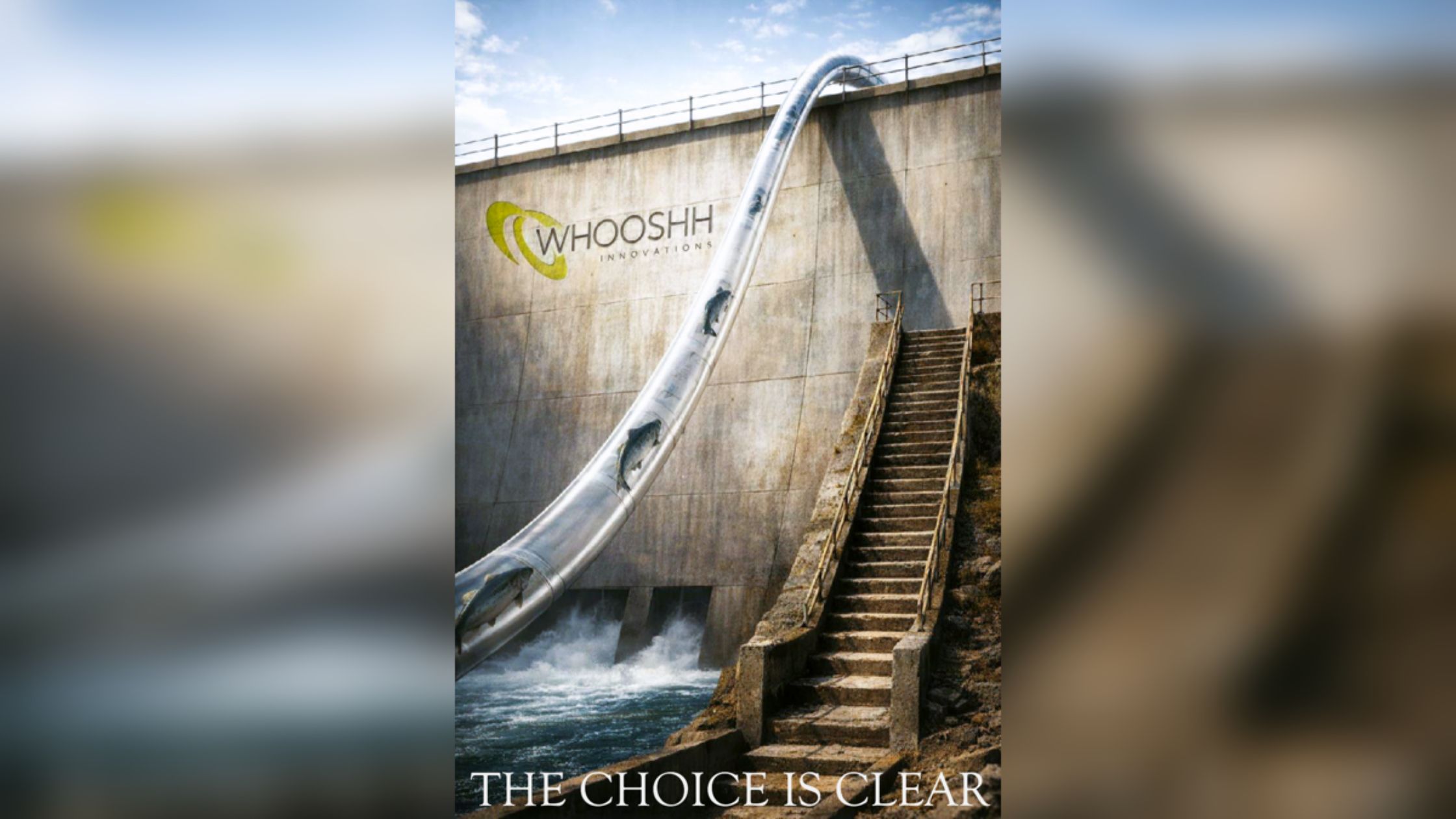
The framing that has dominated hydropower policy conversations for decades is a binary one: dams or fish. You can have clean energy or you can have healthy rivers, but not both. At Whooshh Innovations, we’ve spent over a decade building the case that this framing is wrong. And the technology we’ve developed is the evidence.
The relationship between fish passage and hydropower production is not inherently zero-sum. It has been made to look that way by the limitations of the passage infrastructure that most dams currently rely on. Fish ladders divert significant water from power generation to create the flow gradient fish need to swim through them. Fish elevators have mechanical complexity and throughput limitations. Trap and haul operations don’t affect water allocation but they do require road access, crew presence, and substantial operational cost.
Each of these methods solves the passage problem by taking something away from the hydropower side of the equation. That trade-off is what has made the dams-versus-fish debate feel irresolvable at the policy level.
How Does Pneumatic Passage Change the Hydropower Equation?
The PassagePortal Model F uses differential air pressure of approximately 1 PSI to move fish through flexible MigratorTubes. The system doesn’t need to divert large volumes of water from the forebay to create passage conditions. The attraction flow draws from the tailrace, not the headpond, and the fish transit through air rather than through a water-filled channel.
The practical consequence is that up to 10% more of the river’s flow can remain in the power generation system rather than being diverted for fish passage. At a facility producing hundreds of megawatts, a 10% increase in water available for generation during peak demand hours is a direct and meaningful revenue impact.
This is precisely why Whooshh systems have been recognized by both the U.S. Department of Energy and the National Hydropower Association for their contribution to making hydropower and fish passage more compatible. The recognition isn’t for being a good fish passage system that tolerates hydropower. It’s for being a system that actively improves the hydropower economics of facilities where it’s deployed.
What Are the Operational Benefits for Dam Operators Specifically?
For the business of operating a hydroelectric facility, the PassagePortal Model F delivers a set of operational improvements that go beyond the basic passage compliance question:
- Up to 10% more water allocated to power generation rather than fish passage diversion
- No sediment accumulation to shovel out of passage channels or ladders during maintenance windows
- Autonomous 24/7 operation that reduces the on-site staffing requirement for passage monitoring
- Real-time FishL Recognition data that satisfies compliance documentation requirements without additional monitoring programs
- Modular installation that deploys in days rather than the years a conventional ladder requires
- Maintenance downtime measured in hours rather than the weeks or months a ladder can require for annual service
How Does Selective Passage Protect Hydropower Interests Over the Long Term?
This is a dimension of the fish passage hydropower production relationship that rarely gets discussed in the standard policy debate. A conventional passage structure that passes all fish indiscriminately, including invasive species, creates long-term ecological problems that eventually generate new regulatory pressures on dam operators.
Invasive species that establish themselves in upstream habitat don’t disappear. They generate ongoing ecosystem damage that conservation regulators respond to with additional compliance requirements. An operator who inadvertently facilitates invasive species dispersal through their passage structure may find that the long-term regulatory cost of that outcome exceeds the short-term compliance cost they were trying to satisfy.
The PassagePortal’s selective passage capability sorts fish at the individual level and prevents non-native species from accessing upstream habitat through the passage structure. That’s a proactive risk management tool for dam operators, not just a conservation benefit. Read more about how fish passage solutions work at Whooshh.
Is the Dams-Versus-Fish Framing Finally Ready to Retire?
We think so. The technology now exists to pass fish more efficiently, more selectively, and with better data quality than any conventional passage structure delivers, while simultaneously improving rather than degrading the hydropower economics of the facility.
The published Whooshh blog on unlocking hidden hydropower makes the case in detail for why the combination of improved passage and better power production isn’t just possible but is actively being achieved at deployed sites.
The dams-versus-fish debate was always a proxy for a technology limitation. The technology limitation is now largely resolved. What remains is the adoption curve. For dam operators ready to move ahead, the conversation starts here, and the Whooshh Innovations homepage is the right place to start understanding the full picture of what’s now possible.